Monday, December 5, 2011

Paris pour Noel

"Did you stop blogging because you weren't traveling?"

It's a fair question. In the winter I wrote about books and knitting, not always in that order. And I didn't travel.

Now I'm back in Paris, at Villa Monceau. Since my allotted month this year is December, why NOT be here for "les fetes." Luckily for me, various friends and family have accepted invitations to join me from time to time.

Paris is dark early in the morning, and goes from light to dark very quickly late in the afternoon. Then the lights come on. Rue de Courcelles, the main street of the immediate neighborhood, is hung with decorations that remind me of the lights strung across Main St. in Moscow, Idaho, circa 1956. Nice then, nice now.

I'm learning to blog from an iPad - how does one upload a picture? No blog post until I figure it out!


- Posted using BlogPress from my iPad

Location:Villa Monceau,Paris,France

Thursday, February 24, 2011

Winter


A good time for knitting and reading. The scarf required concentration that got in the way of other things.

After finishing many long lines of garter stitch, I went back to reading - more of Ismail Kadare, this time Chronicle in Stone, a novel based on his memories of a wartime childhood. Kadare grew up in Gjirokaster, an Albanian city that was invaded and occupied during WWII first by Italians, then Greeks, the Italians again, then Germans, and finally Albanian Partisans, who ushered in Enver Hoxha's long dictatorship. (Kadare also invokes previous invaders - the Slavs, the Ottomans and the Romans, among others.)

I enjoy memoirs and history, but often a novel can tell the truth far better than non-fiction. Kadare was only 4 or 5 when the war began, but the novel's main character is older. An introduction to the book says Kadare has revised and edited the work several times since its initial appearance in 1971.

Nevertheless, when reading Chronicle in Stone, you feel this is what it was really like to be a child in a war-wracked city, nowhere near the main battlefields of that war, but constantly affected by far-away incomprehensible events.

Recently the UU Partner Church Council Chatline had a lively discussion of books to read before going to Transylvania. Along with recommendations for histories of all descriptions came a few suggestions for novels. (I recommended Miklos Banffy's 3-volume Transylvania Trilogy, which I don't really expect people to read, although I've been raving about it for 10 years to anyone who would listen.)

Then, last fall, after a 5th trip to Romania, I finally read the classic we all avoid mentioning: Dracula.

"Dracula," the name, not the novel, is the first thing most people talk about if you tell them you're going to Transylvania. Bram Stoker, the author, had only a cursory acquaintance with Transylvania, and yet his descriptions, over-wrought and intentionally foreboding as they are, can be startlingly accurate. The train journey from Cluj to Bucharest goes through jagged mountains that seem to rise straight up from roads and rails, through dense dark green forests. It's easy to let the imagination run.

What's interesting about Dracula the book, is the insistence, throughout, on its modernity. It is written as a series of letters among a number of characters who often contrast their contemporary, progressive world (of the late 19th century) with the primitive superstition represented by the idea of the undead. When they must deal with ancient horrors, they communicate by the ever-present telegraph, and rush back and forth by train.

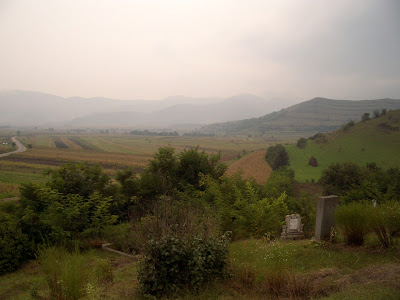
It's a good read, but I'm glad I waited! Here's a picture of the real Transylvania, far from dense forests and forbidding mountains...(but that IS a graveyard in the foregound.)
Wednesday, January 19, 2011

Full moon

The moon is huge, full, completely in the clear, and it's making a shining path across the lake and directly into the window east of my desk.

In the middle of the path is a sailboat, completely dark against the lighted water. If anyone tried to paint this scene, it could end up as a cheesy silhouette on a background of shiny paper, and would give viewers no idea at all of its true beauty. I just feel lucky to have seen it at all, because the sailboat has now moved out of the shining path, and I can't even see its green running light.

Winter moons are the best, because we so often don't see them as anything other than light behind a cloud layer.

No pictures. I've tried that before, and it only leads to frustration!

Sunday, January 16, 2011

Albania


I've never been to Albania, and in spite of a continuing fascination with Eastern and Southeastern Europe, I'm not even sure I'd want to go.

More than any former Communist country, Albania has been "the other" - the strange, the unknown, the unknowable. In junior high school, I read a young adult book about brave partisans in what must have been 30's or 40's Albania. Even then I knew that things had changed, and that it probably wasn't a good idea to recommend the book. (In WWII, Albania was invaded by Axis countries, and Communist partisans were armed by the U.S. and Britain to resist both Italian and later German forces. After the war, things changed rapidly!)

After 1991 things changed again, and in 1992, a family friend went to Albania for a two-year stint in the Peace Corps. He wrote about the desolate state of Tirana, the capital city - decayed buildings, broken windows never repaired, wind-blown dust so all-pervasive that everyone had skin ailments of one kind or another.

What interests me about Eastern Europe is learning a little about how people survived under dictatorship. As a visitor, you learn only what residents choose to share. In Transylvania, the one part of Eastern Europe where I've spent significant time, the people I know best are ethnic Hungarians who are citizens of Romania because of 20th-century boundary upheavals. As such, they generally keep their own counsel, and, as another friend says, you learn about them gradually, like peeling away the layers of an onion.

Fortunately for the curious, there are writers. At the moment, I'm learning a little about Albania by reading novels long and short by Ismail Kadare, whose point of view is that "Dictatorship and authentic literature a incompatible. The writer is the natural enemy of dictatorship." Kadare, born in 1936, now divides his time between France and Albania, and managed to survive Enver Hoxha's regime relatively unscathed, although much of his work was banned. His books first became known in Europe through the work of Jusuf Vrioni, who began translating Kadare into French while a political prisoner in Albania.

Kadare's novels range across the whole history of Albania. I've read only three so far, but there are many more. The Concert deals in part with life among the privileged in 1970's Tirana - Party members in good standing, who work in the bureaucracy or are recognized artists. But Kadare's imagination ranges far and wide - into the mind of a dying Mao Tse Tung, or a monitor listening to transmissions from the east at a post somewhere in the Arctic, or a confirmed European leftist, trying to decide whether to back the Soviets or the Chinese.

Last fall I got close to Albania - as near as Kotor, on the coast of Montenegro. Further south are the ruins of Butrint, a UNESCO World Heritage site, and I suspect the Albanian coast is as dramatic and beautiful as the rest of the Balkan peninsula.

Friday, December 24, 2010

Happy Christmas to all...

Outside it's raining. Inside there's a fire in the fireplace, and the cat is drowsing on her very own hearthrug. I'm listening to a favorite album -


- so long a favorite that I bought it first on LP, then tape, then CD. Now I can pull it out of the air.

Earlier tonight we had a light dinner at Gainsbourg, in Greenwood - dark, spacious, a gas fire on one wall, old trunks used as tables in front of comfortable couches, good food, interesting cocktails, absinthe if you dare. Since it is named for the Serge Gainsbourg, there's a cocktail called a Jane Birkin, as well as a Brigitte Bardot. Not forgetting the old reliables - Kir Royale (my favorite) and French 75.

It's going to be the dinner-and-a-movie (or two or three) Christmas. After Gainsbourg, we went back to I & Z's house, and watched "Holiday Inn," a movie I'd never seen. Although it's famous for introducing "White Christmas" to the world, it should be equally famous for Fred Astaire's July 4 dance among exploding fireworks.

Tomorrow Ian is cooking dinner - and he has a lineup of film noir classics we MUST see. Since the rain is forecast to go on for at least the weekend, this all sounds perfectly reasonable.

Before I go to sleep, I'll listen one more time to Alan Maitland reading "The Shepherd," courtesy of the CBC program, "As It Happens." If you haven't heard the program, it's worth checking out (NPR carries it.) "The Shepherd," which runs every Christmas Eve, is a lovely ghost story.

Sunday, December 19, 2010

Five days to Christmas Eve...


The tree survived, the wind abated, and this morning the sun is shining. From the deck the view looks like this picture, except that there are even fewer clouds.

I should be out walking, for the Vitamin D and the exercise and easing a gimpy back. Physical therapist's advice is to walk on even ground, but if you try that in this neighborhood, you'd be confined to the two blocks in front of the building. So I plod uphill & down, assuming it will all even out eventually!

Time to finish and mail the last of the holiday letters. As much as I enjoy staying in touch with people, the logistics of note-writing, folding, stuffing & mailing feel much more of a chore than the actual writing of the letter. That's hard (but rewarding) work, especially if one aspires to stay out of the "awful Christmas letter" category.

"Santacon" hit Seattle yesterday - hundreds of people dressed as Santa or his helpers, gathering at 12:30 p.m. at the Fremont Troll, then spreading out to walk, ride or bar-hop for the rest of the day. A giggling group got on a bus I was riding, and everyone smiled as they trooped by to take over the entire back section.

My favorite was the young woman dressed as Santa - in a short red dress, black tights and boots, a short furry jacket, and a long white stick-on beard and mustache.

Saturday, December 18, 2010

Holidays


Outside the wind is blowing like crazy, and I'm watching the one remaining maple tree below the building lash back and forth. For years I've expected it to go down someday, but hope its roots are still strong enough to survive winds and saturated ground.

Earlier this week a large evergreen planted close to a neighboring building simply fell over, its roots no longer able to hang on. The tree came to rest against power lines and stopped, remaining in place until it was cut down, a day or two later.

It's Christmas, almost. This year we're still without a plan for the 25th, although something will emerge soon. L & D are going to the Methow for a much needed break. Those of us remaining here have kicked around various ideas - including a movie and Chinese food.

Here's a wreath for any season, courtesy of the Viena (sic) Bistro in Kolozsvár (Cluj-Napoca) Romania.


And here are pictures full of sunshine, from the Playa de la Concha in San Sebastian, where this sculpture by Eduardo Chillida "combs the wind."